Proven at enterprise scale

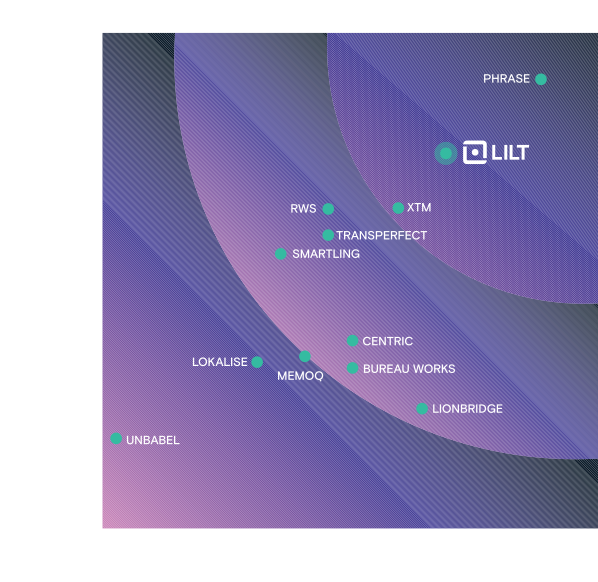
Forrester Wave™ Leader
Named a Leader in The Forrester Wave™: Translation Management Systems, Q3 2025, with the highest score possible in 13 criteria, including workflow automation and AI agents.
Intel: 40% lower cost
Translation cost, year over year, for the same volume of content.
ASICS: 70% lower cost, 60% faster
Year over year, after replacing a fragmented vendor stack with one connected platform.
TRUSTED BY THE MOST INNOVATIVE ENTERPRISES, GOVERNMENT, and AI/ML BUILDERS







WHO IT'S FOR
Built for every team that touches website content
Marketing teams
Translate campaigns, landing pages, and blog content inside your CMS. No file exports, no engineering tickets, no waiting on a vendor queue while a launch date moves.
Web and product teams
Connect your repositories and CMS once. Every new page and changed string routes to translation automatically, on the same cycle as your releases.
Localization managers
One governed platform for all website content: translation memory, glossary enforcement, QA automation, and real-time reporting on cost, quality, and coverage.
Regulated industries
Private cloud, on-premises, and air-gapped deployment for programs where content cannot leave your environment.
Connect your CMS
LILT connects directly to Contentful, Adobe Experience Manager, WordPress, Webflow, Salesforce, Zendesk, Shopify, Figma, GitHub, and 100+ more. Content is extracted automatically. There are no file exports, no copy-pasting between systems, and no proxy layer sitting between your site and your users.

Content routes to the right workflow
New and changed content is detected and routed automatically. High-volume, lower-risk content such as support articles, product descriptions, and release notes runs through adaptive AI translation. Pages that carry brand or compliance risk, including homepages, legal disclosures, and regulated content, route to expert human verification.

Quality compounds over time
Every correction a human verifier makes retrains the model on your terminology, your brand voice, and your content. An error corrected in release one does not recur in release forty. Per-word cost falls as the model learns. This is the difference between an adaptive model and a fixed machine translation engine, and over a multi-year program it is the largest single driver of cost per page.

Translations publish back automatically
Approved translations push to your CMS with localized URLs, hreflang tags, and metadata intact. Continuous localization means new content is translated on the same cycle as your releases, so localized versions ship alongside your source-language build rather than weeks behind it.
What changes when you run website translation on LILT
The same website content, without the manual handoffs or the fixed-model ceiling.

Content sync
Translation architecture
AI quality
Human review
Regulated content
Audit trail
Cost over time
ASICS replaced a fragmented vendor stack with one connected platform
The result: 70% year-over-year decrease in localization cost, with 60% faster translation turnaround.
Cost and speed usually trade against each other. They moved together at ASICS because the constraint being removed was manual coordination rather than linguist hours. Adaptive models reduced per-page human effort while connector-based workflows removed the handoffs between the content team and the translation process.

How is LILT different from proxy-based website translation?

Which CMS platforms does LILT connect to?
Is expert human verification the same as post-editing?
Can LILT be deployed on-premises for regulated industries?
Entering new markets?
Website translation is the content layer. For how LILT helps teams adapt their sites for new markets, including multilingual SEO, market prioritization, and per-locale performance, see the website localization program overview →