Enterprise Translation
September 04, 2026
|
5 min read
Translation Is Solved. Verification Is Not.
At SlatorCon San Francisco 2026, LILT CEO Spence Green argued multilingual is now a first-class AI problem. Translation is largely solved; the real job is verification: confirming output is truthful, on-policy, and correctly formatted. The multilingual model gap is missing regional and cultural knowledge, not language.

LILT Team
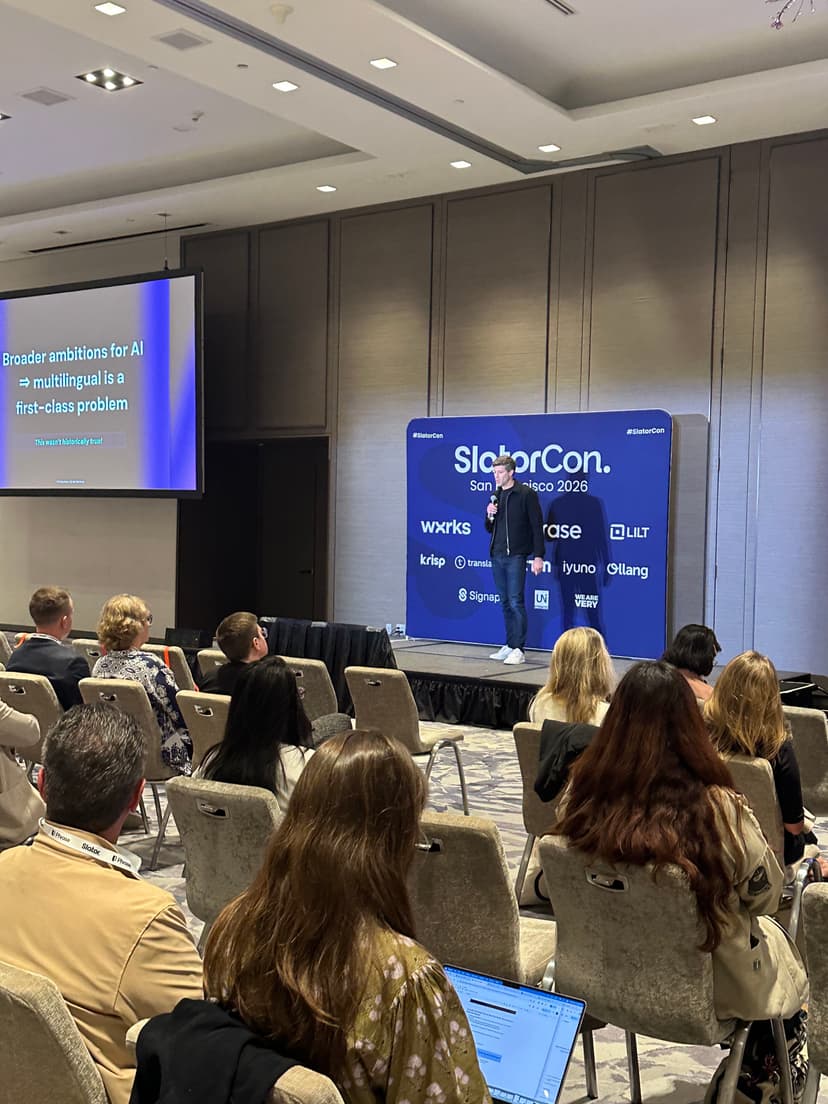
TL;DR: At SlatorCon San Francisco 2026, LILT co-founder and CEO Spence Green argued that multilingual has quietly become a first-class AI problem, and that the work in front of localization teams is no longer translation. It is verification. The benchmarks the industry uses to decide whether an agent is ready are almost entirely English, the multilingual versions of them are usually machine translated and unreliable, and the performance gaps they hide are not language gaps. They are knowledge gaps.
Spence opened by admitting he had changed his topic. The question he wanted to put to the room was blunt: is multilingual still something we should care about and work on?
His answer was yes, but not for the reason most of the audience expected.
Multilingual just became a first-class problem
Ten years ago, Spence said, the ambition of AI was simply to get anything to work at all. Summarization did not work. Natural language understanding did not work. Question answering did not work. Dialogue did not work.
"One of the only things that did work was translation," he said. "Not great, but it worked reasonably well."
That shaped a generation of research priorities. English was the target, other languages were an afterthought, and multilingual was a niche that a small group of researchers cared about.
That has inverted. "If the ambition of AI is to rewire every economy and every business and every part of society with intelligent systems, then you need these systems to work capably in every language," he said. "It's now become a first-class problem for all the labs and all the people building models."
For localization leaders, this is the most important shift in the talk. The work your team has done for years, defining what good looks like in a market, is now on the critical path for enterprise AI, not adjacent to it.
The real job is verification
Spence was direct about how he thinks of LILT now, after being introduced as running a translation company: "I don't think about that anymore. I think about it as verification."
Translation is largely solved. Put a document in, get a translation out. The question that actually matters is whether the output meets three criteria:
- Truthful, and grounded in the right context.
- On-policy, against brand, risk, legal, and compliance requirements.
- In the correct data shape, which is increasingly multimodal and multi-format.
That framing applies to anything an AI system produces, not only translated content. And it is the part no model release solves for you.
The benchmarks are mostly in English
Every few weeks a new frontier model launches with a chart pointing up and to the right. Spence's warning: "The secret of these benchmarks is almost all of them are in English."
The multilingual versions are usually worse than nothing. Take an English benchmark, push it through a low-quality MT system, and call it multilingual. The problem is that modern benchmarks encode regional, cultural, economic, and societal knowledge, so the translated version is not measuring what you think it is. His example: the legal section of a widely cited economic benchmark is full of questions about Texas state law. Translate that into Arabic and it stops making sense.
This is why LILT now builds benchmarks for both the labs training models and the enterprises deploying agents.
He showed two. The first was a multi-turn conversational reasoning benchmark, the kind of turn-taking interaction you see in customer support. Constructed properly, English led Arabic, German, and Korean by ten to fifteen points. "You can produce this shape of chart for pretty much any model capability you want," he said.
It is not a language problem
The instinct is to blame language understanding. Spence rejected that outright: "These systems are superhuman in language understanding."
The causes sit lower in the stack. Tokenizer inefficiency means other languages consume far more tokens than English. Latent space misalignment means the model's internal representation is heavily biased toward English. And because complex reasoning is trained mostly on English data, models tend to default to English-centric reasoning on non-English tasks.
The second benchmark proved the point. Terminal-Bench-LILT is an agentic coding benchmark built from tasks natively authored by native speakers rather than translated in. If comprehension were the bottleneck, converting those tasks back into English should lift scores. It does not. In LILT's published results, swapping the native prompt for English moved pass rates by no more than seven percentage points.
"It is something about the regional knowledge and cultural knowledge that's encoded in the model that's missing," Spence said, "and that's what you have to fix."
He also made a point worth sitting with. Software engineering used to require English. Now a developer can write software in Korean, Arabic, or Finnish through an agentic coding tool. The population of people depending on multilingual model performance is growing quickly.
Two problems to solve: capability and deployment
Spence closed with where the work actually is.
Model capability is fixed with new tasks and new knowledge, not with more translated data.
Deployment has three components:
- A verified eval, built from your real tasks and goals. Most frontier evals are produced by American companies and American universities, and they carry that perspective. Broadening them across languages is open work.
- Model and harness preparation, to maximize performance against that eval. "You get a lot of mileage out of the harness these days."
- System and workflow integration, to operationalize it inside how your organization actually works, market by market.
This is familiar territory for localization teams. Defining acceptable quality, encoding regional knowledge, and routing the right expert to the right content is the discipline you already own. What has changed is the scope of what depends on it.
NVIDIA's Faylene Bell, Senior Director of Web Operations, Digital Marketing, described the shift on their program this way: "We needed a partner who could help improve our translation model. That's a different level of partnership. The ability to feed updates and improvements back into the model has been incredibly impactful."
Key takeaway: capability announcements are not evidence of readiness in your markets. Until you have a verified eval in the languages you operate in, you do not know what your agents do outside English.
Start with where you actually are. Take the two-minute AI-Native Multilingual Content Maturity self-assessment, see your stage, and get your next move.
Frequently asked questions
What did Spence Green argue at SlatorCon San Francisco 2026?
That multilingual has become a first-class AI problem, and the work in front of localization teams is no longer translation but verification. If the ambition of AI is to rewire every economy with intelligent systems, those systems have to work capably in every language, which puts the discipline of defining market quality on the critical path for enterprise AI.
What is verification in multilingual AI?
Verification is confirming that an AI system's output meets three criteria: it is truthful and grounded in the right context, on-policy against brand, risk, legal, and compliance requirements, and in the correct data shape, which is increasingly multimodal and multi-format. Translation is largely solved; verification is the part no model release solves for you.
Why do AI models underperform in non-English languages?
Not because of weak language understanding, which is superhuman. The causes sit lower in the stack: tokenizer inefficiency, a latent space biased toward English, and reasoning trained mostly on English data. The missing piece is regional and cultural knowledge, shown by Terminal-Bench-LILT, where converting native tasks back into English moved pass rates by no more than seven percentage points.
Why are standard benchmarks unreliable for multilingual evaluation?
Almost all frontier benchmarks are in English, and their multilingual versions are usually low-quality machine translations of English tests. Because modern benchmarks encode regional, cultural, and economic knowledge, a translated version stops measuring what you think it does. The fix is a verified eval built from your real tasks in the languages you actually operate in.
Quotes are from Spence Green's remarks at SlatorCon San Francisco 2026, lightly edited for readability. The seven-point ablation figure is from LILT's published Terminal-Bench-LILT results. Related reading: GAIA-v2-LILT, on how much of the measured multilingual gap is benchmark-induced measurement error.
Share this post


Find some time with LILT
Enterprise-grade content seamlessly translated with AI to help your business scale globally.
Book a MeetingShare this post