






SFT

Supervised Fine-Tuning Data That Scales Across Languages And Domains.

Design Supervised Fine-Tuning (SFT) workflows that improve instruction following, domain grounding, and safety—without sacrificing consistency across locales.​

Abstract featured image showing a text box, a pencil icon, and a photo placeholder on a dark gradient background, representing content editing or media creation
canva-logo
intel-logo
lenovo-logo
asics-logo
us-air-force-logo
us-department-of-defense-logo

Why LILT for SFT

Science-driven annotation design

Science-driven annotation design

Research-designed frameworks that prioritize precision and reproducibility for production AI systems.​

Global coverage, localized correctness

Global coverage, localized correctness

Proven methods to normalize judgment across diverse cultural contexts and low-resource language variants.​

Production-grade governance

Production-grade governance

Identity/compliance controls plus ongoing QA, calibration, and agreement tracking to keep SFT data stable over time.​

Overview

SFT performance gains depend on data quality, —and data quality depends on consistent human judgment.​
LILT co-designs and operates SFT programs that produce training data with measurable reliability across languages, domains, and modalities.​

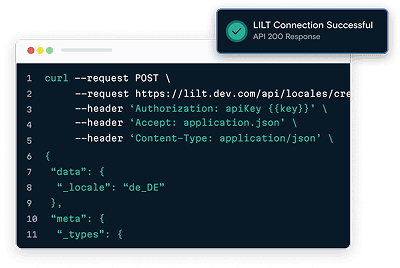
Code snippet showing a cURL API request with a success message popup.

SFT programs we run

  • Prompt–response authoring and targeted rewrites aligned to your instruction regime.​Prompt–response authoring and targeted rewrites aligned to your instruction regime.​
  • Preference and judgment data to complement SFT with alignment-ready signals.​Preference and judgment data to complement SFT with alignment-ready signals.​
  • Domain grounding + RAG validation to verify answers follow the provided context and constraints.​Domain grounding + RAG validation to verify answers follow the provided context and constraints.​
Code snippet showing a cURL API request with a success message popup.

Challenges

  • High variance across languages, domains, and evaluator populations can erase SFT gains.​High variance across languages, domains, and evaluator populations can erase SFT gains.​
  • Scaling volume often breaks consistency when governance is missing.​Scaling volume often breaks consistency when governance is missing.​
Code snippet showing a cURL API request with a success message popup.

How LILT delivers

  • Task design: Rubrics, boundary cases, anchors, and gold sets as measurement instruments.​Task design: Rubrics, boundary cases, anchors, and gold sets as measurement instruments.​
  • Workforce: Multi-stage qualification by language/domain/task behavior and continuous monitoring.​Workforce: Multi-stage qualification by language/domain/task behavior and continuous monitoring.​
  • Quality system: Longitudinal agreement tracking, outlier detection, and drift intervention.​Quality system: Longitudinal agreement tracking, outlier detection, and drift intervention.​

Build SFT datasets that hold up across every market.