Enterprise Translation
April 14, 2026
|
4 min read
The AI-Native Advantage: Why Your Translation Stack Is Costing You a "Fragmentation Tax"
Legacy translation stacks rely on "bolted-on" AI, creating a costly fragmentation tax through disconnected tools and static data. LILT’s AI-native, built-in architecture eliminates these silos. By using real-time adaptation, LILT transforms your translation process into an appreciating asset that scales quality and efficiency across your entire enterprise.

LILT Team

You’ve likely seen the pitch: "Our platform now features AI." In today’s market, every legacy translation provider is scrambling to add a "layer" of artificial intelligence to their existing services. But for the enterprise buyer, there is a fundamental architectural distinction that determines whether your global content strategy is an appreciating asset or a growing liability.
The difference lies in AI-Native vs. Bolted-On architecture.
The Fragmentation Tax: The Hidden Cost of "Bolted-On" AI
Most translation stacks today are a patchwork of disconnected legacy tools — a Translation Management System (TMS) here, a third-party Machine Translation (MT) engine there, and a separate manual review shop at the end. When these companies "add AI," they are simply bolting a new engine onto an old frame. At every touchpoint between systems, there’s a risk of loss, inefficiency, redundancy, and breakage.
This creates a Fragmentation Tax: the compounding cost of manual data movement, broken context, and "static" learning.
- Data Silos: Your style guides, termbases, and translation memories live in separate files, forced to "talk" to an AI that doesn’t truly reside with them.
- Static Learning: These systems can only adapt to fixed resources. If you update a termbase, you might see the change eventually, but the system doesn't understand the change in real-time.
Redundant Labor: Because the AI and the human workflow are disconnected, you pay for the same corrections over and over again.
Built-In vs. Bolted-On: A Rigorous Comparison
To audit your current stack, ask: Is the AI the substrate, or just a feature?

Custom Model Adaptation: Driving Precision At Scale
Bolted-on providers offer generic models or typically use an orchestrator approach, routing content through various third-party engines. This creates a fragmentation tax where brand terms are handled inconsistently across different models. This "Black Box" logic makes it impossible to know why the AI chose a specific translation, leading to a total loss of predictability for brand managers.
LILT replaces this guesswork with AI-native architecture and high-performance models custom-built for your organization. We fine-tune these models with your unique brand assets and domain-specific data, such as healthcare or finance, to ensure compliance. Unlike others, we build custom models for every customer and every data source. This allows you to keep content separate, such as marketing and technical content, ensuring your brand voice remains precise across every context.
Many bolted-on translation providers offer a single adapted model per language pair per customer. Even the latter approach is insufficient to cover the nuanced needs of large global businesses.
LILT’s approach to model adaptation is built for the complexity of the enterprise. We offer unlimited adapted models, customized and fine-tuned to specific business domains within the enterprise.
Real-Time Adaptation: Turning Data into an Appreciating Asset
The industry standard for "adaptation" often follows two paths: either you use a generic model, or you are stuck with a vendor’s training cadence. LILT operates on a different spectrum.
Our Adaptive AI Engine doesn't wait for a project to finish to learn. It learns from every single keystroke. When a human verifier corrects a term, that knowledge is instantly synthesized into your unified context database.
This turns your language data into an asset that appreciates over time. In a bolted-on world, you pay for human labor as a recurring expense. With LILT’s AI-native approach, your investment in human verification actually decreases the future cost of your translations. As your model sees more of your data, its autonomous accuracy climbs, allowing you to shift budget from "fixing errors" to "expanding reach."
Workflows and Interface: Built for the AI-Era
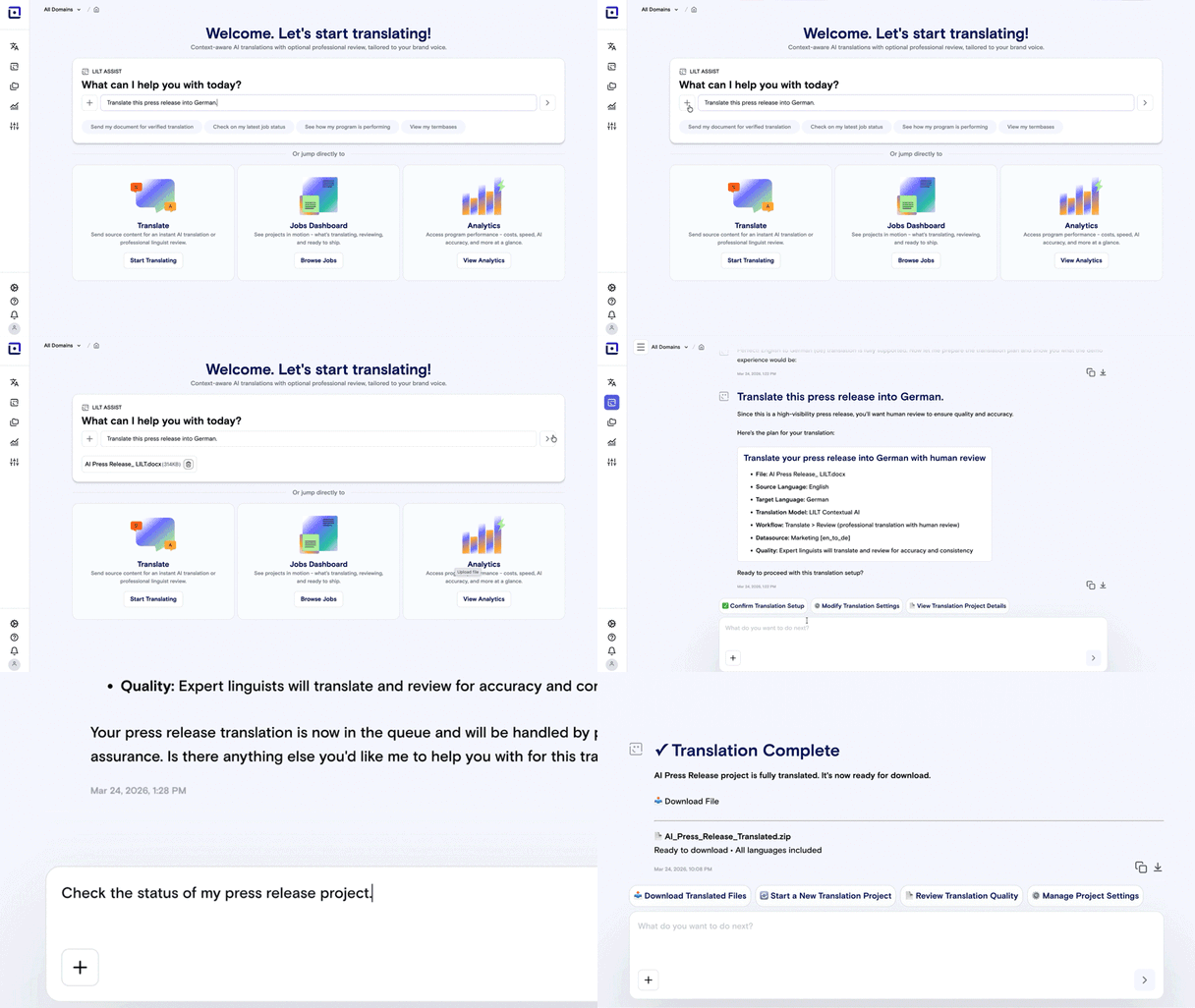
The way we work is shifting from "clicking buttons" to "describing outcomes."Because LILT is AI-native, we have rebuilt our interface to reflect this and through agentic workflows like AI QA and AI Review. AI QA operates as an automated quality check that flags accuracy and formatting issues for immediate resolution, while AI Review identifies and scores error-prone segments to route high-risk content for human verification. This built-in intelligence eliminates manual intervention and accelerates time-to-market by ensuring that human effort is focused exactly where it is needed most.
Our new LILT Assist agent uses a natural language interface that allows you to manage your entire global multilingual operation through chat. Whether you need to "Translate this campaign for the LATAM market with a formal tone" or "Audit consistency in Japanese over the last quarter," the system understands the intent because the AI is the foundation of the UI, not a widget on the side.
Note: For teams who prefer the classic workflow, our previous interface remains fully supported—but the underlying AI-native engine powers both equally.
Performance Transparency vs. Guesswork
Bolted-on systems create a critical risk: the "Black Box Effect." When legacy providers route content through third-party APIs, they lose visibility into the engine's internal mechanics. This lack of transparency makes it nearly impossible for leaders to justify costs or demonstrate ROI to the C-suite.
LILT’s AI-native architecture replaces guesswork with total transparency via enterprise-level dashboards:
- Real-Time Accuracy Tracking: Monitor how custom models evolve in quality and accuracy in real time, rather than waiting for quarterly reviews.
- Measurable Efficiency: Gain direct visibility into AI-driven gains, seeing exactly how human effort decreases as the model matures.
- Data-Backed ROI: A unified data layer provides the metrics needed to prove translation spend is an appreciating technology investment.
In a bolted-on world, you pay for a black box and hope for the best. With LILT, you manage a transparent, high-performance operation where every improvement is measured, reported, and refined.
The Future-Proof Decision
Choosing a translation partner is no longer about finding the best "per-word" rate; it’s about choosing an architecture that won't be obsolete and ensures long-term competitive agility. A bolted-on system will always be limited by the legacy code beneath it. An AI-native system like LILT evolves at the speed of the models themselves.
Stop paying the fragmentation tax. It’s time to move your multilingual operations onto a foundation built for the future.
Connect with LILT
Scale your global operations with a built-in, not bolted-on, AI strategy. Unlock custom models tailored to your brand with the AI-native advantage.
Book Your AI Native Strategy SessionShare this post


Connect with LILT
Scale your global operations with a built-in, not bolted-on, AI strategy.
Book Your AI Native Strategy SessionShare this post